วันเสาร์ที่ 23 มกราคม พ.ศ. 2553

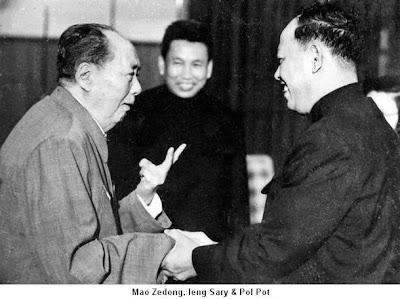
Beijing in denial over its role in the KR regime?

https://blogger.googleusercontent.com/img/b/R29vZ2xl/AVvXsEjHGu7Wiam2ijLH4F2J_FndZtcNrhSelmUGUE3pBShnUZrTReAFcWeTjxC47lIGr0M48OIbrrQI9CbYX8MuUd6xO4laT9MwWz31Vg8OWYvcEkc2iov8ssWyTECILRePiKf4cMLUqPwfvB0/s400/KR+killing+01+-+Mao-Pol-Pot.jpg
China Played No Role in Khmer Rouge Politics: Ambassador

By Kong Sothanarith, VOA Khmer
Original report from Phnom Penh
22 January 2010

China’s ambassador to Cambodia told a group Friday that the Chinese had not aided the Khmer Rouge but had sought to keep Cambodians from suffering under the regime.

“The Chinese government never took part in or intervened into the politics of Democratic Kampuchea,” the ambassador, Zhang Jin Feng, told the opening class at Khong Cheu Institute.

The Chinese did not support the wrongful policies of the regime, but instead tried to provide assistance through food, hoes and scythes, Zhang said.

“If there were no food [assistance], the Cambodian people would have suffered more famine,” she said.

The comments come as the Khmer Rouge tribunal prepares for its second trial, of five high-ranking members of the regime.

However, a leading documentarian of the regime said the Chinese may want to revise that statement, given all the evidence that points to their involvement with the Khmer Rouge.

“According to documents, China intervened in all domains from the top to lower level: security, including the export of natural resources from Cambodia, like rice, bile of tigers, bears and animal skins to exchange for agriculture instruments,” said Youk Chhang, director of the Documentation Center of Cambodia.

“In the domain of security, Chinese advisers trained units to catch the enemy, and some of the trainers went to inspect the outcome of the training at the local level,” he said.

China maintained close diplomatic ties with the Khmer Rouge after they came to power. It was one of only nine communist countries to keep an embassy in the country after April 1975.

UN Agency To Prioritise Development Areas In Cambodia

PHNOM PENH, Jan 22 (Bernama) -- The Cambodian government has said that its development partner, the United Nations Development Programme (UNDP), is planning to prioritise five areas for development projects in the country from 2011 to 2015, China's Xinhua news agency reported.

A statement released by the Council for the Development of Cambodia (CDC) on Friday, said government officials from various institutions had held a meeting with their development partner UNDP to review the implementation of projects assisted by the UNDP in 2009 and the ongoing projects for years ahead.

The statement said the meeting was chaired by Keat Chhon, deputy prime minister and minister of the economy and finance, and also the first vice chairman of the CDC.

From 2006 through 2010, the UNDP were focusing on governance; promotion of human rights protection, agriculture and poverty in rural area; capacity building and human resource development; and national development plan.

UNDP has assisted Cambodia between 80 million and US$120 million a year.

Phnom Penh on human rights report: Deny! Deny! Deny!

Phnom Penh rejects human rights report as "insulting"

Jan 22, 2010
DPA

Phnom Penh - The Cambodian government Friday rejected the annual report of a prominent human rights organization that warned respect for rights in the country had 'dramatically deteriorated' last year.

In its assessment, also released Friday, Human Rights Watch called on donors to exert pressure on the government to reverse the trend.

But government spokesman Phay Siphan hit back, saying the report was unprofessional, lacked balance and was insulting. He said HRW had ignored the role of Cambodian institutions, and stressed that reform had to come 'little by little.'

'We understand that any government has its flaws - so we are not sleeping on the problem,' Phay Siphan said. 'Criticism is information, and we would have to consider that, but insulting is not [useful] information.'

The report by the US-based organization singled out Phnom Penh's forced return to China in December of 20 asylum seekers belonging to the Uighur ethnic minority as a particular low point.

'Cambodia's deportation of the Uighurs was a glaring example of the government's failure to respect human rights,' said Brad Adams, HRW's Asia director.

The HRW report was released while the UN's special rapporteur on human rights, Surya Subedi, was visiting Cambodia. Subedi is in-country for two weeks to assess national institutions and how well they serve ordinary Cambodians.

Among the institutions Subedi will examine is the judiciary, a body Human Rights Watch said was being misused by the government to silence its critics in politics, the media and civil society.

'As the political space shrinks for human rights and advocacy groups to defend themselves, there are valid concerns that a pending law to increase restrictions on non-governmental organizations will be used to shut down groups critical of the government,' Adams said.

Human Rights Watch complained that Cambodians who tried to defend their homes, jobs and human rights faced 'threats, jail and physical attacks.'

It called on donors, who last year contributed about 1 billion US dollars to the impoverished South-East Asian nation, to pressure the government to respect human rights.

Other subjects covered in the report were the ongoing problem of forced evictions and the use of armed police and soldiers to evict people, as well as poor prison conditions and allegations of torture by police.

Human Rights Watch also condemned new legislation that limits freedom of assembly to fewer than 200 people, for which permission must be gained in advance, and said freedom of association remained under pressure.

The expulsion from Phnom Penh of the 20 Uighurs, who fled China after deadly unrest in the far-western province of Xinjiang in July, preceded a visit to Phnom Penh by Chinese Vice President Xi Jinping, during which China signed economic assistance deals worth 1.2 billion dollars.

A torrent of international criticism saw Cambodia hit back at its critics with one government minister deriding the UN refugee agency in Phnom Penh as 'the laziest office' in the country for failing for weeks to begin processing the Uighurs' claims.

China is wise to put brakes on its economic growth

January 23, 2010
The Nation

CHINA, which is expected to overtake Japan this year as the world's second largest economy, is putting the brakes on its turbo-charged growth.

The world's most populous nation of 1.3 billion reported a breakneck year-on-year growth of 10.7 per cent for the fourth quarter of last year.

Its December 2009 inflation also jumped to 1.9 per cent from a negative inflation last July, while bank lending rose sharply last year.

Bubbles are brewing in its vast property sector and China's central bank has signalled that it is on the way to tightening the country's monetary policy.

On a quarter-on-quarter basis, China's GDP growth had slowed down from 10 per cent in the third quarter to 8.5 per cent in the fourth quarter of 2009, according to a DBS Group report.

The slowdown appears to have followed China's winding down of its massive economic stimulus package worth US$600 billion (Bt19.8 trillion) launched early last year.

According to the report, fixed-asset investment has gone nowhere since April/May 2009. Secondly, loan growth dropped by half last June to about 16 per cent from 34 per cent in mid-2008.

Third, the government's budget deficit, which provided a lot of stimulus between June 2008 and June 2009, started to disappear.

The report also argues that China, in fact, started its exit strategy seven months before anybody became aware of it, while the recent interest rate and bank reserve-requirement hikes are just continuations of this trend.

China's monetary policy will further be tightened as inflation has risen from 1.9 per cent year on year in December from 0.6 per cent in November.

Given this, interest rates will likely go up in the third quarter, dampening the domestic demand as China further withdraws its fiscal stimulus programme.

Overall, this could affect China-bound exports from other Asian economies, including Thailand, which has seen its shipments to the Middle Kingdom rise at a rapid pace in the past years.

For this year, the Bank of Thailand's GDP projection is a positive growth of 3.3 to 5.3 per cent as the Thai economy contracted 2.7 per cent in 2009.

Given a slowing Chinese economy and relatively weak recoveries of the US, the euro zone and Japan, Thailand's 2010 GDP growth may not be as strong as previously thought, largely because exports still account for more than 60 per cent of it.

However, the government's Bt1.43-billion Thai Khemkhaeng economic stimulus package remains intact for 2010-2011.

In addition, the tourism sector appears to have recovered since December.

As a result, Prime Minister Abhisit Vejjajiva expressed confidence that growth could still be in the range of 3 to 3.5 per cent despite increased external uncertainties.

Another positive development is that on January 1, China and the six original members of Asean - Thailand, Malaysia, Indonesia, Singapore, the Philippines and Brunei - started to enforce the zero import tariff scheme, covering more than 90 per cent of products, to further promote intra-regional trade.

The scheme will only cover the initial six countries for the first five years, after which it will be joined by Vietnam, Laos, Cambodia and Burma, creating the world's largest free-trade area with nearly 1.9 billion people.

Rogue general gives Bangkok the jitters

https://blogger.googleusercontent.com/img/b/R29vZ2xl/AVvXsEjcRdaqOf0OtfmLk-vk9Zgs3GtFXDTUpsezoofcJAa45xfYufQ7HTnvGkpL9WmL5MN3J0gHC26d3KuJnVR5urr2c48QSiw32YYCWohEqbExLnX0iIrgKQAT1jUQ_1ymkaUC9hyljrsR22o/s400/Red+shirts+demo+in+Bangkok+%28Reuters%29.jpg
Thai “red shirt” supporters cheer during a rally at Rajamangala Stadium in Bangkok. — Reuters pic

The Straits Times

BANGKOK, Jan 23 — Thai police have found caches of weapons in the houses of rogue army Major-General Khattiya Sawasdipol and some associates in a raid, bringing the underlying volatility of the country’s political conflict into sharp focus.

The major-general is now under investigation over a grenade attack last week on a building in the Thai army’s headquarters in Bangkok, which houses the office of army chief Anupong Paochinda.

Nobody was injured in the attack, which appears to have been meant as a warning, analysts said.

Days before, Khattiya had been suspended for insubordination over his continued high-profile support of anti-government “red shirts”, as well as an unauthorised visit to Cambodia to meet ousted premier Thaksin Shinawatra.

The grenade attack spooked the government, and also pointed to the possibility of fissures in the army.

Prime Minister Abhisit Vejjajiva yesterday called a meeting of the National Security Council, telling reporters afterwards that the government had acted according to the law, so the red shirts had no reason to resent the raids.

Foreign Minister Kasit Piromya also briefed diplomats on security measures in the event of protests in Bangkok — especially at the airport — in coming weeks.

He spent much of the time explaining the Thai government’s achievements and objectives, while police and army officers were on hand to brief the diplomats about security and contingency plans for ensuring that Suvarnabhumi International Airport stays open.

The focus on the airport was sparked by a plan announced this week by the red shirts of the United Front for Democracy against Dictatorship (UDD) to stage protests on the road to the terminal.

The stock market dipped on news of the plan, as traders recalled the closure of the airport by the right-wing People’s Alliance for Democracy (PAD) in 2008.

The red shirts, however, have since dropped the idea of the airport protests.

Last week’s grenade attack compounded the jittery atmosphere in the capital.

Khattiya, a maverick combat veteran better known by his colourful nickname Seh Daeng, has openly defied the army’s top brass.

After his suspension, he reportedly said that only the Thai king could fire him, and that he could make it difficult for General Anupong to walk the streets if the army chief persisted in targeting him.

In 2008, he gave dozens of young men daily combat training in full public view, saying he was grooming them to protect red shirts from the PAD, which was then campaigning to oust the Thaksin-loyalist People Power Party government.

Khattiya relishes the maverick, folk-hero image attributed to him, and is often scornful of “golf soldiers” — indicating a vein of resentment present in some quarters of the army, of officers who are promoted to privileged posts because they are close to some of the capital’s elites.

But while he supports the red shirts and has occasionally turned up at red-shirt rallies, he is not a regular member — but “just an ally”, one red-shirt leader told The Straits Times.

วันศุกร์ที่ 22 มกราคม พ.ศ. 2553

Cambodia's largest labour union demands 'real killers' be arrested in leader's 2004 murder

Friday, January 22, 2010
ASSOCIATED PRESS

"Cambodians who speak out to defend their homes, their jobs, and their rights face threats, jail, and physical attacks" - Brad Adams, Human Rights Watch Asia Division Director

PHNOM PENH, Cambodia — Cambodia's largest labour union warned Friday that it would launch a nationwide strike unless authorities arrest those responsible for the killing of their prominent leader six-years ago.

Chea Vichea, 36, founder and president of Free Trade Union of Workers, was fatally shot in front of a newsstand in the capital Phnom Penh on Jan. 22, 2004. He was known for his outspoken efforts to organize garment workers and improve working conditions in Cambodia.

Two men were convicted in the deaths and sentenced to 20-year prison terms, but many people believed they were framed for the crime and the country's Supreme Court has ordered a retrial.

Chea Mony, the slain leader's brother and current leader of the union, marked the sixth anniversary of the killing by leading a march of nearly 100 workers and a dozen opposition legislators to the spot where the shooting took place. The march was held under heavy security but was peaceful and no one was arrested.

"Today, I wish to send a message to the government that it is time to arrest the real murderers," Chea Mony said. "If the government continues to ignore our appeals, then we will hold a one-week, nationwide strike," he said, adding it would come some time this year.

In December 2008, Cambodia's highest court provisionally released the two men convicted in the Chea Vichea killing - Born Samnang, 24, and Sok Sam Oeun, 36 - and ordered further investigation in preparation for their retrial.

The court did not give a reason, but the decision came after widespread protests over the convictions.

The Cambodian government, meanwhile, denounced a critical report by Human Rights Watch released this week.

The New York-based rights group said in its annual World Report that "the government misused the judiciary to silence government critics, attacked human rights defenders, tightened restrictions on press freedom, and abandoned its international obligations to protect refugees."

"Cambodians who speak out to defend their homes, their jobs, and their rights face threats, jail, and physical attacks," said Brad Adams, director of its Asia division.

Responding to the report, Cabinet spokesman Phay Siphan said Friday that Cambodia's human rights situation is improving every year thanks to government efforts. "That report sings the same old song and is not a truly scientific report," he said.

Disaster-prone Southeast Asia comes up with landmark pact

https://blogger.googleusercontent.com/img/b/R29vZ2xl/AVvXsEhkR8oHLtfT0pTA54BBPQj_uU4fvQaazbCO9rOD1hZT6g80NaxVFO-VFKClw_tFjcAaN8FjrBhYggvoD2De6eClC5D9RV2XEU_2aeNLWOmHJpMg24pGKXX1TafMH8qLtOsfS_PufyLt1-xl/s320/232323.jpg
A villager walks past houses damaged by Typhoon Ketsana in Cambodia's Kampong Thom province 168km (104 miles) north of the capital, Phnom Penh in this photo taken September 30, 2009. REUTERS/Chor Sokunthea


22 Jan 2010
Written by: Thin Lei Win

BANGKOK (AlertNet) - Name a natural disaster, any disaster. Be it a typhoon, earthquake, volcanic eruption, landslide or tsunami -- all 10 countries that make up Southeast Asian bloc ASEAN have experienced them all.

The region suffered 152 natural disasters in 2008 according to ASEAN, with the biggest being Cyclone Nargis which tore through Myanmar killing nearly 140,000 people.

More recently, a 7.6-magnitude earthquake hit Indonesia in October, around the same time successive typhoons battered Philippines and flooded Vietnam, Cambodia and Laos.

The region is so vulnerable to the force of nature that many in the aid community call it 'the supermarket for disasters'.

It's this constant exposure that has spurred ASEAN, the Association of Southeast Asian Nations, to agree a legally binding pact to establish national and regional structures to deal with disasters -- the first of its kind.

"This is the Kyoto Protocol of disaster management. It's a watershed for all of us," Jerry Velasquez, senior regional coordinator for U.N. disaster agency UNISDR told AlertNet.

ASEAN hopes the ASEAN Agreement on Disaster Management and Emergency Response (AADMER) will improve the region's ability to coordinate a response and boost its resilience to future disasters by making sure that early warning and preparedness are in place.

Experts have welcomed the pact as an encouraging move in the disaster-prone region, but enforcing it will be a big challenge for the bloc which is often criticised as a toothless organisation.

CHALLENGES

Under the agreement, which came into force on Dec. 24, 2009, governments of Brunei, Cambodia, Indonesia, Laos, Malaysia, Myanmar, Philippines, Singapore, Thailand and Vietnam are required to draw up national plans on managing disasters -- ranging from early warning and preparedness to rehabilitation and scientific research.

"AADMER will help the countries look at the same picture because they will actually have to do things step-by-step," Velasquez said. "In the past, some did the strategic national plans, some didn't. It's the same for standard operating procedures. But now because of the binding nature, all (member countries) will have to do this."

Importantly, the agreement has provisions for simplifying customs and immigration procedures in times of disasters, to avoid the kind of confusion and delays aid workers experienced in the aftermath of Nargis.

However, there is no system of sanction for countries that fail to live up to their obligations which means there is no stick to shake at member states that refuse to request aid in the aftermath of a major disaster or share scientific research.

Other concerns include the lack of sufficient numbers of staff in the ASEAN secretariat to coordinate the implementation of such a wide-ranging agreement; and funding.

Although the pact has been ratified by ASEAN, it could take years for member countries to pass the necessary changes in legislation to reflect the new agreement.

For ASEAN though, the agreement itself is a major achievement.

"Disasters occur every year and they have affected millions of people in the region," Dhannan Sunoto, head of ASEAN's disaster management & humanitarian assistance division, said. "So disaster management is something ASEAN needs to have in order to reduce the number of victims."


Reuters AlertNet is not responsible for the content of external websites.
Cambodian garment workers threaten week-long strike

https://blogger.googleusercontent.com/img/b/R29vZ2xl/AVvXsEjBfwluHL_zBBr0fJ_j8ZwFA-YqI2oqRrkH8K4nw6uWsC2Vq7v3ZjdJuUNmkvh58KyKpe6QgeC1E98dyrA4TUNXvENpf_LnkHR0tvlnFcpLC1onYVtSU45Sn5zBKpaWn7wKoiliB4Sz-Cg/s400/Chea+Vichea+commemo+2010+03+cops.jpg
Police officers watch over a march held to mark the anniversary of the death of Chea Vichea, former president of the Free Trade Union of the Workers of Cambodia, in Phnom Penh, yesterday. The union, Cambodia's largest, said yesterday it would launch a nationwide strike unless authorities arrest those responsible for shooting dead Vichea at a news stand in the capital in January 2004. Two men were convicted of the deaths and sentenced to 20-year prison terms, but many people believed they were framed and the Supreme Court has ordered a retrial.

PHNOM PENH, Jan 22 (Reuters) - Two of Cambodia's biggest workers' unions on Friday threatened to hold a nationwide garmet-industry strike to protest over low pay and the unsolved murder of the country's most respected union leader.

Two unions said thousands of garment factory workers would halt production for a week to press the government to arrest the killers of top unionist Chea Vichea, as hundreds marched in Phnom Penh to mark the sixth anniversary of his killing.

A workers' strike would represent a rare test for the government of long-serving Prime Minister Hun Sen, who has used a parliament dominated by his Cambodia People's Party (CPP) to push through tough laws to stifle dissent.

It comes at a tricky time for Cambodia as it tries to recover from a sharp economic decline that followed an unprecedented four-year boom before the global financial crisis took its toll.

Garment factories employ 330,000 workers in Cambodia and are vital to the impoverished country's nascent economy. Garments are Cambodia's third-biggest earner behind agriculture and tourism.

It exported $1.95 billion worth of garments in 2008 to its biggest market, the United States, up from $1.27 billion in 2004, according to the Commerce Ministry. Last year's figures are not yet available.

The workers are supporters of Chea Vichea, a vocal critic of Cambodia's business and political elite who was shot dead in January 2004. Two men were sentenced to 20 years in prison for his murder.

'GRAVE INJUSTICE'

The United Nations said their conviction was a "grave injustice" and rights groups said the pair were framed.

The Supreme Court in December 2008 ordered their release on bail pending a review of the case. There have since been no new arrests.

The two unions threatening action were the Free Trade Union (FTU), which represents 78,000 garment workers and the Cambodian Labour Federation (CLF) with 50,000 members from the same sector.

"We send this message to the government that it's time to find the killers, for the family, to make us calm," said Chea Mony, brother of Chea Vichea and president of the FTA.

CLF president Ath Thon said the outspoken Chea Vihea was a "hero" among garment workers because he fought for an increase in their minimum monthly wage from $30 to $45 during the 1990s.

He said workers were having difficulty making ends meet and they would also use the strike to demand a pay increase.

"Our workers don't have enough to spend, their health is getting weaker, they eat less, live in bad places and work hard," Ath Thon added. The unions did not say whether they would stage a protest alongside the strike. Cambodia's parliament approved a law in October banning demonstrations of more than 200 people and requiring five days notice for smaller protests.

That, and a tightening of defamation laws, sparked criticism from opposition lawmakers and rights groups, which said the government was trying to intimidate its critics and crack down on freedom of expression.

Cambodian national police spokesman Kirth Chantharith declined to comment on Chea Vichea's murder investigation but said there would be no attempt to block the strike as long as workers sought permission from the authorities.

"We have laws on demonstrations and police are ready to respect them," he said.

If Tuol Sleng Documents are fake

Friday, January 22, 2010
Op-Ed By Baphuon

If Tuol Sleng Documents are fake, manipulated, falsified, doctored, and fabricated by Hanoi, it would be an earthquake of tremendous Richter scale which hits Cambodia recent History.

It would change forever the History of Cambodia as we usually knew until these days. Because Cambodia History as we knew until now was written generally by scholars and academic researches that were based on these documents which were provided by Hanoi, and supposed to be Khmer Rouge documents which were collected at Tuol Sleng Prison by the Vietnamese invasion army as the Khmer Rouge fled to save their skin under the hot pursuit of Vietnamese forces.

If the quoted premise is true, that is if Tuol Sleng Documents are fake, manipulated, falsified, doctored, and fabricated by Hanoi, then all the books and scholar researches would be wrong because based on wrong and manipulated facts. In Cambodia History as we usually knew, white would be in reality black, and black would be white, day would be night and vice versa. Vietnamese invasion forces instead of saving Cambodian people, they were coming in reality to destroy Cambodia; Cambodia attacked Vietnam turned out in reality, Vietnam attacked Cambodia in 1978 to swallow Cambodia. And Vietnam became responsible of Cambodia genocide.

Vietnam cannot hide anymore behind a smiling face telling the world that they invaded Cambodia to save Cambodian people from the extermination by Pol Pot armed forces.

If Vietnam invaded Cambodia in order to really save Cambodia people why did Vietnam manipulate, falsify, fabricate, and doctorate Tuol Sleng documents?

Tuol Sleng Documents were deposited at Document Center of Cambodia (DCCam) and Yale University.

The ECCC (Khmer Rouge Tribunal) cannot make verdict of Khmer Rouge leaders without assuring first the authenticity of any document she used for the verdict. So the ECCC must prove the authenticity/falsity of all Khmer Rouge documents provided by Hanoi.

The ECCC cannot trust on expert opinion either because if the expert opinion was based on Khmer Rouge documents provided by Hanoi inevitably, irrefutably the expert conclusion would be wrong because the staple documents provided by Hanoi were manipulated.

A dozen of Cambodian who worked for the Vietnamese invasion Army in 1979 still alive, living around the world, in the USA, Europe and Cambodia, had worked for the Vietnamese invasion Army at that time and under Vietnamese officer order had fabricated, manipulated, falsify Tuol Sleng documents which were later became Khmer Rouge document at Tuol Sleng left by the Khmer Rouge leaders who fled for their life as the Vietnamese invasion army chased them.

These Cambodian witnesses are ready to testify before any international commission, US commission, European commission or any organization set up by any big power commission if some security measures were met because Cambodia is ran by a fascist regime which eliminated all witnesses, judges and investigators and their families members who testified against them.

But if a commission is created to prove the authenticity/falsity of Tuol Sleng documents, finally at the end, it will be “You said, I said”.

Our Witnesses will say this Vietnamese/Cambodian officer was the responsible of the manipulation of Tuol Sleng Documents. The defendant Vietnamese/Cambodian officer would say: No, it was not me. I knew nothing etc...

But still we think there have a way to find the truth. We thought the FBI lab can certainly help to prove the authenticity/falsity of Tuol Sleng Documents.

We urge the world to help Cambodia to render justice to families of million victims of genocide.

We urge the UN, the US and the EU to set up a committee to prove the authenticity/falsity of Tuol Sleng documents. That is the very important key point to discover the truth of Cambodia genocide.

Government Forcibly Evicts 60 Disabled Veterans ... to make way for the despised Yuon rubber plantation

01/22/2010
ShortNews.com
Source: www.phnompenhpost.com

60 disabled veterans and their families were among the hundreds of people forcibly evicted from the Kraya commune, in Cambodia, in December. The government claimed that all the families were given land to move to, but the families claim otherwise.

The 60 disabled veterans recently moved back to the Kraya commune and are harvesting their cassava fields and hiding from the government officials, knowing that if they are caught, they will be sent back to the relocation site.

The evicted vets claim the land at the relocation site is of poor quality and no land was marked off for them. The veterans and hundreds of people were evicted from Kraya so that a Vietnamese rubber plantation could use the land.

Annual human rights report condemns Cambodia, says donors must act

Jan 22, 2010
DPA

Phnom Penh - A prominent human rights organization warned Friday that respect for human rights in Cambodia 'dramatically deteriorated' last year and called on donors to exert pressure on the government to reverse the trend.

The report by the US-based Human Rights Watch singled out Phnom Penh's forced return to China in December of 20 asylum seekers belonging to the Uighur ethnic minority as a particular low point.

'Cambodia's deportation of the Uighurs was a glaring example of the government's failure to respect human rights,' said Brad Adams, the Asia director at Human Rights Watch.

The report was released while the UN's special rapporteur on human rights, Surya Subedi, was visiting Cambodia. Subedi is in-country for two weeks to assess the country's institutions and how well they serve ordinary Cambodians.

Among the institutions Subedi was examining is the judiciary, a body Human Rights Watch said was being misused by the government to silence its critics in politics, the media and civil society.

'As the political space shrinks for human rights and advocacy groups to defend themselves, there are valid concerns that a pending law to increase restrictions on non-governmental organizations will be used to shut down groups critical of the government,' Adams said.

Spokesmen for the Cambodian government were not immediately available to comment on the report.

Human Rights Watch complained that Cambodians who tried to defend their homes, jobs and human rights faced 'threats, jail and physical attacks.'

It called on donors, who last year contributed about 1 billion US dollars to the impoverished South-East Asian nation, to pressure the government to respect human rights.

Other subjects covered in the report were the ongoing problem of forced evictions and the use of armed police and soldiers to evict people as well as poor prison conditions and allegations of torture by police.

Human Rights Watch also condemned new legislation that limits freedom of assembly to fewer than 200 people, for which permission must be gained in advance, and said freedom of association remained under pressure.

The expulsion from Phnom Penh of the 20 Uighurs, who fled China after deadly unrest in the far-western province on Xinjiang in July, preceded a visit to Phnom Penh by Chinese Vice President Xi Jinping, during which China signed economic assistance deals worth 1.2 billion dollars.

A torrent of international criticism saw the government hit back at its critics with one government minister deriding the UN refugee agency in Phnom Penh as 'the laziest office' in the country for failing for weeks to begin processing the Uighurs' claims.

CNN to air "World's Untold Stories: Innocence for Sale"

January 22nd, 2010
Swati Arya
TVnext.in

In a new "World's Untold Stories" program airing on January 26th, CNN travels to Cambodia to examine the heartbreaking stories of Southeast Asia's child sex industry.

Seen through the eyes of Aaron Cohen, CNN goes undercover into the karaoke brothels where sex with a child costs the same as a round of drinks. We witness the destitution and deprivation that keeps the young girls in the brothels and we're there when Cohen pays his final respects to the teenage girl he'd rescued, but couldn't save from the heartless grip of prostitution, in the face of her family's poverty.

What's uncovered in this half-hour will shed new light into the dark corners of the human trafficking problem in Cambodia, where we discover in many cases, the blame for the children's exploitation lies not solely with the pimps and madams.

The documentary will enlighten and inspire new conversation about e challenges currently preventing aid workers and authorities from declaring battle in the struggle to free children from this most despicable form of modern-day slavery.

Airtimes: Indian Standard Time (IST)
Tuesday, January 26th: 1900hrs, 2300hrs
Saturday, January 30th: 2300hrs
Sunday, January 31st: 1730hrs
Monday, February 1st: 0830hrs

Cambodia labor union marks killing of leader

https://blogger.googleusercontent.com/img/b/R29vZ2xl/AVvXsEiFxbcoOP-QzFI7BUyc3v6oQkMw5-lQPtdJ0MgpnrM_PncVMnZvtDz4M8wSnUSusQT1VZkYhyphenhyphenz_T-BEHep3ab4bzUGrw-axcCIXEk_R7hW0mVbv_FzFri2qCD3KBNXvzZcpilrMKvyrAaU/s400/Chea+Vichea+commemo+2010+02+%28Reuters%29.jpg
January 21, 2010

PHNOM PENH, Cambodia (AP) — Cambodia's largest labor union warned Friday that it would launch a nationwide strike unless authorities arrests those responsible for the slaying of their prominent leader six years ago.

Chea Vichea, 36, founder and president of Free Trade Union of Workers, was fatally shot in front of a newsstand in Phnom Penh on Jan. 22, 2004. He was known for his outspoken efforts to organize garment workers and improve working conditions in Cambodia.

Two men were convicted in the deaths and sentenced to 20-year prison terms, but many people believed they were framed for the crime and the country's Supreme Court has ordered a retrial.

Chea Mony, the slain leader's brother and current leader of the union, marked the sixth anniversary of the killing by leading a march of nearly 100 workers and a dozen opposition legislators to the spot where the shooting took place. The march was held under heavy security but was peaceful and no one was arrested.

"Today, I wish to send a message to the government that it is time to arrest the real murderers," Chea Mony said. "If the government continues to ignore our appeals, then we will hold a one-week, nationwide strike," he said, adding that the strike would come some time this year.

In December 2008, Cambodia's highest court provisionally released the two men convicted in the Chea Vichea slaying — Born Samnang, 24, and Sok Sam Oeun, 36 — and ordered further investigation in preparation for their retrial.

The court did not give a reason, but the decision came after widespread protests over the convictions.

Dog nominated 4-golden star general by Hun Xen? (Chien nommé général 4 étoiles par Hun Xen?)

Y Chhien handsomely compensated by Hun Xen for kowtowing to Hanoi about 07 January?

Y Chhien nominated to 4-golden-star general by Hun Xen

Thursday, January 21, 2010
By E.B.
Cambodge Soir Hebdo
Translated from French by Luc Sâr

The Pailin governor was given a promotion. He is now joining the rank of 2,000 other generals in the RCAF.

It was during the inauguration of business buildings and new army barracks inside the Cambodian Royal Navy headquarters held in Phnom Penh on Monday 18 January, that the Pailin governor, Y Chhien received the precious honor from Hun Sen’s hand, The Cambodia Daily reported.

Hun Xen also indicated that he wanted to promote soldiers who have served in the army in the past. Y Chhien, Pol Pot’s former bodyguard and secretary of the KR division 415, is joining the rank of about 20 generals who hold the rank of 4-golden stars.

In 2006, among the 110,000-soldier-strong RCAF, 613 held the rank of general, i.e. a ratio of 1 general per 179 soldiers. This ratio is far higher than that of the US army in 2004. In the US, the ratio is one general per 1,347 soldiers.

Cambodia: Rights Defenders Under Fire

22 Jan 2010
Source: Human Rights Watch

(New York) - Cambodia's respect for basic rights dramatically deteriorated in 2009 as the government misused the judiciary to silence government critics, attacked human rights defenders, tightened restrictions on press freedom, and abandoned its international obligations to protect refugees, Human Rights Watch said today in its new World Report 2010.

The 612-page World Report 2010, the organization's 20th annual review of human rights practices around the globe, summarizes major human rights trends in more than 90 nations and territories worldwide. Cambodian human rights defenders were threatened, arbitrarily arrested, and physically attacked during 2009, Human Rights Watch said. Victims included staff and volunteers of human rights organizations, as well as community-based activists working on land rights, natural resource exploitation, and forced evictions.

"Cambodians who speak out to defend their homes, their jobs, and their rights face threats, jail, and physical attacks," said Brad Adams, Asia director at Human Rights Watch. "The only way that the Cambodian government will end its assault on civil society is if influential governments and donors demand real change and put the pressure on."

Violations often occurred during mass evictions when police and soldiers frequently used unnecessary or excessive force. For example, on January 24, the streets of central Phnom Penh were filled with heavily armed soldiers firing teargas and water cannons as they forcibly evicted hundreds of families from the Dey Krahom community. In March, police opened fire on unarmed farmers protesting confiscation of their land in Siem Reap province, seriously wounding four villagers.

More than 60 community activists were imprisoned or awaited trial - often on spurious charges - for helping to organize and represent fellow community members facing eviction or illegal confiscation of their land.

Urban poor evicted from their homes were often dumped in squalid relocation sites far from the city that lack water, social services, and access to jobs.

At least 10 government critics - including four journalists and several opposition party members - were sued for criminal defamation and disinformation by government and military officials, the report says.

"As the political space shrinks for human rights and advocacy groups to defend themselves, there are valid concerns that a pending law to increase restrictions on nongovernmental organizations will be used to shut down groups critical of the government," Adams said.

The report details other key issues including political violence, the lack of accountability by government officials involved in abuses, arbitrary detention and abuse of sex workers, and substandard prison conditions.

Over 2,000 people who use drugs were arbitrarily detained in 11 government-run drug detention centers, where arduous physical exercises and forced labor are the mainstays of their "treatment," and torture is common. Even if an assessment concludes that an individual is not dependent on drugs, the centers continue to hold some detainees arbitrarily.

One of the year's low points was the government's forcible deportation of 20 Uighur asylum seekers from Cambodia to China on December 19, without an examination of their refugee claims. This action was a clear violation of Cambodia's obligations as a state that has ratified the 1951 Convention relating to the Status of Refugees and its 1967 Protocol.

"Cambodia's deportation of the Uighurs was a glaring example of the government's failure to respect human rights," Adams said. "The Cambodian government showed its profound disregard for minimum standards of due process, refugee protection, and international cooperation."

Khmer Krom (ethnic Khmer from southern Vietnam) asylum seekers and migrants faced obstacles to obtaining safe places to live and full citizenship rights in Cambodia, despite pronouncements by the Cambodian government that it considers Khmer Krom who move to Cambodia to be Cambodian citizens.

Thirty years after the fall of the Khmer Rouge, justice for the crimes of that era remained as elusive as ever, Human Rights Watch said. The US$100 million Khmer Rouge tribunal continued to face political interference and made little headway in addressing credible reports of corruption that have plagued the court and undermined its credibility.

Human Rights Watch expressed concerns about the training and material support donors are providing for Cambodian military, police, and counterterrorism units with track records of serious human rights violations. Donors should conduct more thorough vetting of individuals and their units participating in such programs to ensure that none have been involved in rights abuses, Human Rights Watch said.

"While donors may have policy reasons to work with the Cambodian security forces on issues such as terrorism and peacekeeping, they should work just as hard on holding abusers accountable and ending the culture of impunity that exists for high-ranking members of the security forces and those close to Prime Minister Hun Sen," Adams said.

Norwegian man arrested in Cambodia on underage sex charges

Fri, 22 Jan 2010
DPA

Phnom Penh - A 64-year-old Norwegian man was arrested in the Cambodian tourist town of Siem Reap on suspicion of sexually abusing four boys, 11 to 14, national media reported Friday. The man was arrested Wednesday after a boy leaving the man's guesthouse told police he was paid 40 US dollars for sex, Sun Bunthorng, the provincial head of the anti-trafficking department, told the Cambodia Daily newspaper.

Sun said the case would likely go to court Friday in the tourist town, outside of which lies the famous Angkor Wat temple complex.

"It was the first case of this year in Siem Reap," he said, adding that provincial police dealt with three similar cases involving foreign nationals last year.

Samleang Seila - who heads a local non-governmental organization called APLE which combats paedophilia - said APLE began monitoring the Norwegian a year ago after he was seen in contact with several homeless children in Siem Reap.

Cambodia has struggled to rid itself of its reputation as a place where foreign tourists can engage in sex with children.

Samleang Seila said 26 foreigners were arrested on underage sex charges in Cambodia last year, twice the number of 2008. Three of the 26 were subsequently released.

He said the rise in arrests was in part because of improved policing and more foreign paedophiles visiting Cambodia.

This week, a court in the capital, Phnom Penh, sentenced Swedish citizen Johan Brahim Escori, 62, to six and a half years in jail for abusing boys as young as 9.

The judge ruled that Escori, who reportedly has a history of similar sex crimes in his native country, would be deported once he has served his sentence.

Another foreign national, US citizen Harvey Alexander Johnson, 57, is to appear in a Phnom Penh court next month on accusations of committing indecent acts with a 12-year-old girl.

Thank you for sending the invaders' bodies back to rot in Vietnam!

Cambodian specialists honoured for repatriating remains of soldiers

01/21/2010
VOV News (Hanoi)

Individuals and collectives from the Cambodian Royal Armed Forces and Cambodian citizens have been awarded Vietnamese distinctions for their efforts in searching and repatriating the remains of volunteer Vietnamese soldiers to their homeland.

The awards ceremony was held in Phnom Penh on January 21 and co-chaired by Vietnamese Deputy Minister of Defence, Sen. Lieu. Gen. Nguyen Van Duoc and Cambodian Deputy Prime Minister and Minister of Defence Tea Banh.

Deputy Minister Duoc expressed his deep gratitude to the State, government, army and people of Cambodia for their role in locating, collecting and repatriating the remains of volunteer soldiers who laid down their lives in Cambodia during wartime.

He read the State President’s decision to present the Friendship Order to 31 collectives and 10 individuals, and the Friendship Medal to 192 individuals.

He also introduced the Prime Minister’s decision to confer the Certificate of Merit on 38 collectives and 379 individuals, and the Minister of Defence’s decision to grant the Certificate of Merit to eight individuals.

For his part, Deputy PM and Defence Minister Tea Banh praised the effective cooperation between Cambodia and Vietnam in implementing a governmental-level agreement on locating and repatriating the remains of heroic Vietnamese martyrs.

Effective and mutual assistance during difficult times has become an honoured tradition of the two nations, said Mr Tea Banh.

He thanked the Vietnamese government and Ministry of Defence for providing regular assistance to the Cambodian Royal Army and people and expressed his belief that their traditional friendship, solidarity and cooperation will grow even stronger in the future.

The remains of more than 12,000 Vietnamese soldiers have been repatriated during the past 10 years. Specialists from the two countries are searching for another 8,000 remains to be returned to Vietnam in the coming years.

Healing a fractured nation: Cambodians seek justice

Thursday, January 21, 2010
By Kate Fechter
WashburnReview.org

Washburn University and the Topeka Center for Peace and Justice came together to hold the fifth forum in the series Resolving Conflict in a Fractured World Thursday, Jan. 14 at the Washburn School of Law.

Co-sponsored by Phi Alpha Theta, the presentation, “Seeking Justice After Genocide: International Courts and Cambodia,” featured Washburn alumna Samantha Gassie who shared her knowledge of the Cambodian hybrid judicial system. The system includes the Extraordinary Chambers and Courts of Cambodia, which is currently trying to provide justice for the people of Cambodia over the war crimes committed during the reign of the Khmer Rouge.

Gassie, who has a bachelor’s degree in political science and a master’s degree in liberal studies from Washburn, studied in Cambodia when writing her thesis. Bob Beatty, Gassie’s mentor, who told her about the opportunity in Cambodia also spoke at the event, along with Thomas Prasch.

During her time in Cambodia in the fall of 2008, Gassie conducted 17 interviews in fall of 2008. Her interviews ranged from people from the U.S. and Canada who were involved in the legalities, to Cambodian citizens who shared with her their personal accounts of surviving the Khmer Rouge. Everyone above a certain age is either a victim or a perpetrator.

The Khmer Rouge was in total power from 1975-1979. During that time period, an estimated 1.3 to 3.3 million were massacred in the killing fields, amounting to almost 50 percent of the country’s population.

People were brought into S-21 or Tuol Sleng, a school turned into an interrogation center, for questioning. They were tortured until they named five names of usually innocent friends or neighbors and then killed. The people named were then brought in for the same treatment, creating a deadly cycle of violence. Of the 17,000 people that went in, only 12 people total walked out. There are four survivors of S-21 alive today.

The ECCC was established in 2001 by negotiations between the United Nations and Cambodian officials. Gassie said it is a unique war crimes tribunal because it is inside Cambodia, meaning there is a lot of victim involvement. The ECCC and the Cambodian national government are working to set up education to strengthen and improve the credibility of the justice system in the country.

However, the tribunal does have its problems. The process has suffered from a lack of impartiality, because most judges and lawyers are from the victim community. Beyond that, the process itself has been slowed by issues reaching a consensus between the Cambodian judges and the U.N., and finding a balance for victim involvement in the process.

Translation has also been a problem for the tribunal because the court works in three languages: French, Khmer and English. There has been an issue with possible corruption in the translations because Cambodians translate.

Problems aside, there are five people from the Khmer Rouge leaders waiting to stand trial. Gassie spoke about one trial that was already conducted by the ECCC. Comrade Duch, the commander of S-21 was tried in 2009. During his trial, the defense wanted to have him released because they said the court was not credible.

The ECCC cannot hand down death sentences, only life in prison. Most defendants are 80 or older now meaning the trials are more of a healing process for the Cambodians than powerful punishments for the perpetrators. The hope is that the process will help Cambodians to move forward.

“The most hopeful thing is that Cambodians can build a sense of law and order,” Gassie said. “Cambodians can use the ECCC as a stepping stone to move forward and collectively face the atrocities as a nation.”

Gassie is currently working on her doctorate at Arizona State for political science with a major in comparative politics and a minor in international relations. Her capstone project featuring the interviews from her time in Cambodia can be found in the Mabee Library.

“I think ECCC is something everyone should be aware of,” said Dan Locey, a Washburn alumnus who went to Cambodia with Beatty in May 2008. “People my age and younger can’t remember the Khmer Rouge. Any attempt to bring ECCC to light is helpful.”

The Topeka Center for Peace and Justice will be working with Washburn to bring more forums on international justice to campus in the coming months.

Kate Fechter is a junior mass media major. Reach her at kate.fechter-stamper@washburn.edu

Cambodians hold their breath against dam waters, China, overfishing

https://blogger.googleusercontent.com/img/b/R29vZ2xl/AVvXsEjRZGM0xh7vVv9nHpVmt3Je_LAtO2dSptDecZodyjBorudqu4ptwkdXmlstvQgRD1re-JOKSJqeeE1knFyJUw1837MgtaBWr4hHqLlROevdJkwgbZ2-ISB8H974FlIlIAOOAO1wcRsRmVU/s400/Fisherman+on+Tonle+Sap.jpg
Fishermen drowning under threats to livelihood

January 21, 2010
By Nicholas Dynan (Tufts University)
Student Correspondent Corps
Global Post

CHONG KHNEAS, Cambodia — The crowd waits on the muddy banks of the lake in a throng of motorbikes, trucks, bicycles and people. When the colorful fishing boats slide onto shore, the fish buyers clamber onto the decks of the boast and scramble to unpack the fish within the hulls.

The importance of the Tonle Sap Lake in the Mekong Basin cannot be overstated. It provides a major source of protein for Cambodians, including the more than 1 million people who live around the lake.

Fishing is also the sole source of income for most lake residents, though a number of small business enterprises have also sprouted up — including vegetable gardens, fruit and flower tree plantations and hydroponic farming. For most, fishing is all they have, and it keeps them poor.

In recent years, things have gotten even worse. A multitude of issues currently affects the Tonle Sap Lake — among them dams upstream, deforestation, pesticides and overfishing.

Dams

An economic boom in Cambodia has increased the country's need for electricity, which in turn is bringing foreign investment in dams. Electricity is projected to grow at a rate of 20 percent per year over the next several years. China, Laos, Vietnam and Thailand have planned and already begun construction on hydroelectric dams along the Mekong and its tributaries. Many of these dams are being supported by funds from the Asian Development Bank (ADB).

The dams will begin to have an impact in one to two years, threatening the lake's ecology. Since China is responsible for many of the dams and is the largest international investor in the country in general, Cambodia is reluctant to challenge its neighbor to the north.

Access to power will likely improve as a result of the dams, but marine life will perish: Eighty-seven percent of fish species in the Mekong migrate annually to feed and breed. Upstream dams are expected to raise water levels that would widen the lake and destroy up to one-third of the flooded forests where fish spawn.

Deforestation

While deforestation has abated in Cambodia, it continues around the lake. People seeking to develop areas of the flooded forests around the lake clear trees en masse and without thought to the environment. David Thomson, director of the U.N. Food and Agriculture Organization in Cambodia repeats an old Khmer proverb: “No forests, no fish, no Cambodia.”

Pesticides

Chong Kneas is located in Siem Reap province, which is home to famed Angkor Wat and draws millions of tourists every year. According to Thomson, there is a demand for local produce among the growing number of foreign tourists in the area, but he says the tourists don't want food grown with pesticides, which most of the farmers use. Local farmers and fishermen have resisted farming without pesticides, mainly due the fact that many think they will suffer a loss in profit.
Illegal fishing

Illegal fishing — often for family consumption rather than commercial profit — is particularly destructive to the lake's ecosystem since it circumvents fishing limits. Illegal techniques include poison and electric fishing gear, which is used to electrocute fish. Some fishermen bribe their way into restricted areas, and encroach upon fishing sanctuaries.

Government efforts

In 2001, the government made radical changes in fishing policies. More than half of the sections, or “lots” of the lake — about 239,000 square miles of fishing grounds — previously controlled by commercial fisheries were released to lakeside communities.

Thomson calls this an exceptional improvement in fishing management.

“It is almost unique in the world” to take domain from commercial entities and relinquish it to local fishermen. “It is tremendously commendable.”

At the same time, “it is also fraught with great difficulties,” such as management and implementation of a new sustainable fishing policy.

“It is not that easy, but it is a tremendous step forward because all over the world ... fishing rights and fishing access are being taken away from small-scale fishers.”

The trend toward consolidating large-scale fishing has been seen in many African nations, such as Senegal, Angola and Mozambique.

Community fisheries
In Cambodia, community fisheries have been established by the FAO with funds from the ADB (Ironically, the community fisheries are under threat from upstream dams which, are also supported by the ADB). The system of community fisheries works against clearing the flooded forest and pesticides. It also supports community input as well as transparency in the fishing village. The FAO hopes that empowerment will help to reduce corruption and illegal fishing.

A report on this 10-year project of community fisheries is expected to be released within the next few weeks. Local fishermen say they hope progress is notable, but it hasn't been easy to include everyone in the system of community fisheries.
Obstacles to outreach

On his rickety houseboat in the floating village of Chong Khneas, Tan Van Minh, a Vietnamese national living in this Cambodian village, picks at his calloused hands, rough from hours tending his set nets in the Tonle Sap. Tan is one of 2,070 Vietnamese fishermen living in the 6,100-member village.

While he is a resident fisherman, he cannot participate or attend community fisheries meetings because the 2002 Fisheries Sub-Decree includes only Cambodian nationals. Excluding him from the system means he learns less about sustainable fishing. Only the Vietnamese village chief serves as the voice of the Vietnamese during community fishery meetings.

However, many Vietnamese fishers, including Tan, say they know nothing about community fisheries.

Conflict erupts between the Vietnamese and Cambodian fishers at times because of difference in fish catches. Some Vietnamese fishermen are known for staying out on the lake longer and catching more fish as a result. Many also have more money to buy larger nets. The discrepancy in catch between a Cambodian fisherman and a Vietnamese fisherman can fuel ethnic conflict.

In addition, Cambodian inspection officials have been known to target the Vietnamese fishermen. Each year, Tan must put much of his $1-a-day profit toward payment to the fishery inspectors and district inspector. There isn't much left to care for his family.

It is an open secret among fishing villagers in Chong Khneas that rising prices and lack of alternative income has increased illegal fishing. While many of these villagers understand the drawbacks of illegal fishing, daily survival wins out.

As Thomson says, “the problem with the project in early stages is ... it doesn’t put any more rice on the table.”

With the list of threats mounting, the future of the Tonle Sap remains unsure.

Back on shore, the racket of bargaining persists. Crates are filled tight with fish, and men strain under their heavy loads as they carry the boxes to awaiting vehicles. As the last fish is purchased, the noise dies away, and only the carcasses of gutted fish float gently on the surface of the water.

This report comes from a journalist in our Student Correspondent Corps, a GlobalPost project training the next generation of foreign correspondents while they study abroad.

Thai fugitive ex-premier Thaksin ends third Cambodia visit

https://blogger.googleusercontent.com/img/b/R29vZ2xl/AVvXsEh4nm5dXiHsHlfyUnKFeUOYgIF6fwUaVve6q9YxduZ1tX_OOjSvP-_oepvzvQgwgur_Yg7sva7l_SYIubxhGgcrETNErt_Et5hHdHPGhG4zXTLuvqL1_iN4fHl0xjnDOTRS6iIO3AF6DDc/s400/Hun+Sen+shaking+hand+with+Thaksin+%28AFP%29.jpg
Thu, 21 Jan 2010
DPA

Phnom Penh - Thailand's fugitive former premier Thaksin Shinawatra left Cambodia for Dubai Thursday afternoon following an overnight visit, Cambodian government spokesman Prak Sokhon said. The visit was Thaksin's third to the Cambodian capital since being named an economic adviser to the government there in October, a move that put further strains on the already tense relationship between Thailand and Cambodia.

Prak Sokhon said he did not know whether Thaksin had met members of Puea Thai, the opposition political party in Thailand with which he is linked, during his stay.

On previous visits to Cambodia Thaksin met his political supporters from Thailand, who have vowed to escalate anti-government protests there.

Describing Thaksin's stay in Cambodia as "a stopover" en route to Dubai, Prak Sokhon said the former premier had not discussed the economy with government officials or with Prime Minister Hun Sen, with whom he dined Wednesday evening.

"When politicians meet politicians, they talk about politics," he said.

The visit was unlikely to improve ties between Thailand and Cambodia, which remain at their lowest level in years.

Cambodia appointed Thaksin, who has a two-year jail sentence still to serve in Thailand for abuse of power, as an economic adviser to the government and to Hun Sen.

Those appointments and Phnom Penh's refusal to extradite Thaksin outraged Bangkok and saw both countries withdraw their ambassadors and senior embassy staff. The ambassadors have yet to return.

This month, the Cambodian government rejected a demand by Thai Foreign Minister Kasit Piromya that Phnom Penh dismiss Thaksin as an adviser before relations between the two countries could improve.

Bangkok considers the appointment of Thaksin, the de facto opposition leader, as interference in its internal politics.

Thaksin was prime minister of Thailand from 2001 to 2006 before being toppled in a bloodless coup. He fled the country and has lived in self-imposed exile, mostly in Dubai, since August 2008.

The relationship between the two neighbours has been tense for more than a year with a number of clashes reported between their troops over a disputed piece of land near the 11th-century Preah Vihear border temple in northern Cambodia.